

To Carry What Is Missing
An ongoing work of remembrance, witness, and accountability
One boat for every vessel struck. One bead for every person reported killed or presumed dead.
Since September 2025, the U.S. military has been attacking small boats in the Caribbean and Eastern Pacific, killing people it alleges were involved in drug trafficking or criminal organizations. As of October 21, 2026, 72 vessels have been struck and 238 people reported killed or presumed dead. In one attack, two people survived the initial strike, clinging to the wreckage of their boat, only to be killed by a second strike. Others survived the initial attacks but were never recovered from the sea. The strikes continue.
I am making this installation because I cannot bear watching the unthinkable become routine.
I cannot stop the strikes. I cannot return anyone to their family. But I can make something that asks us to stay with what has happened. Something that gives the numbers weight, takes up space, and refuses to disappear when the headlines do.
A fleet made from the record
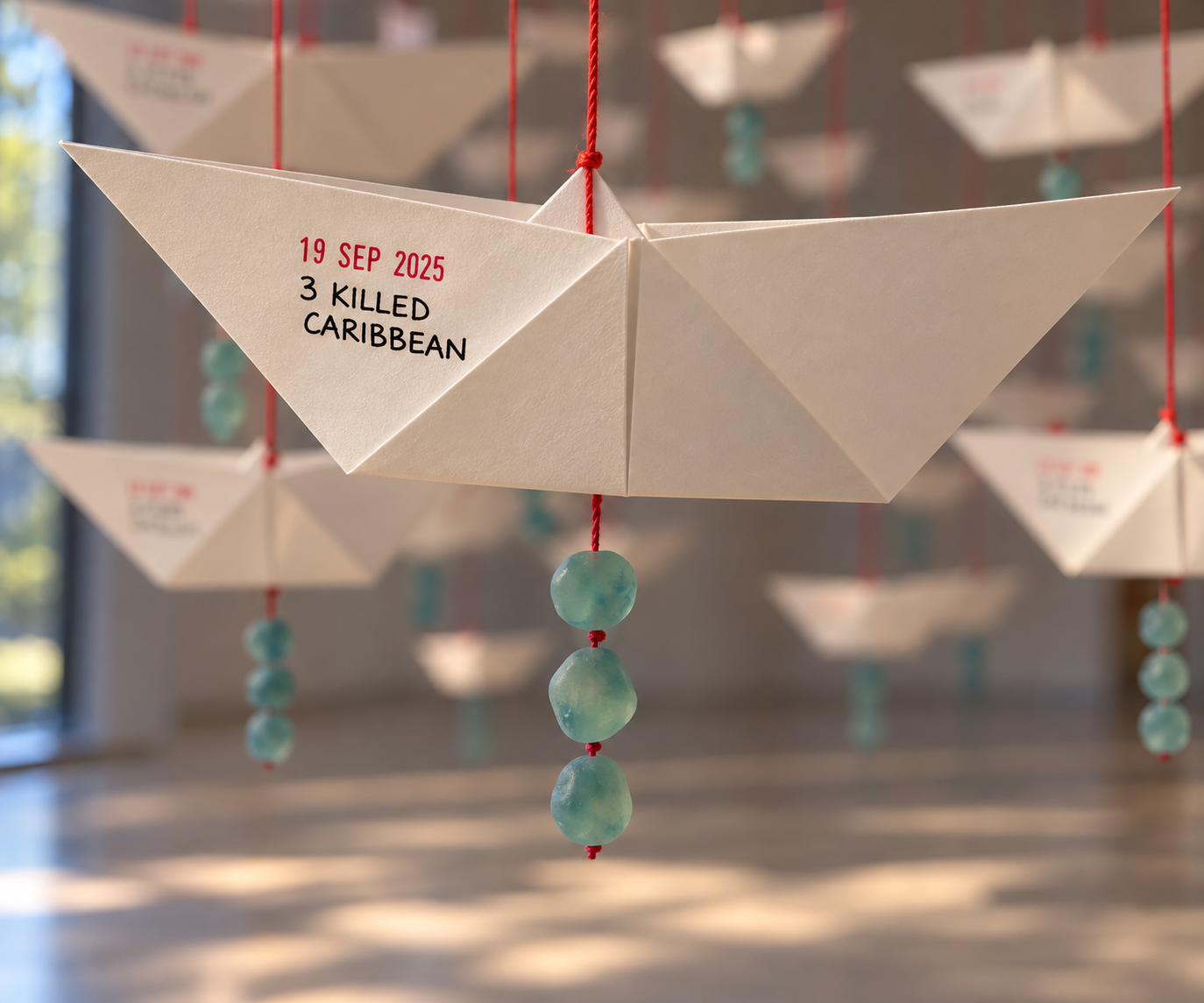
Seventy-two origami boats, each about 12 inches across, have been folded from heavy white paper. Each carries a date stamped in red, along with the location and reported death toll handwritten in black.
Beneath the boats, recycled glass beads hang from red thread, one for each person reported killed or presumed dead. The beads are irregular, each a little different from the next, their translucent blues and greens recalling water, but also something recovered and held up to the light.
The boats are folded by hand. The lettering is imperfect. There is no way to make these things without touching them. Counting them. Handling the evidence of one more death, then another, then another.
The original vessels carried people. These paper boats carry what remains of the public record: dates, places, numbers, and the knowledge that someone was there.
A death toll can be read in a second. Two hundred thirty-eight beads must be counted, handled, threaded, one by one.
What it means to carry
Making boats from paper is a strange contradiction.
They are vessels, but they cannot make the journey. They cannot rescue anyone or carry their passengers safely to shore. What they can carry is a record: evidence that these people existed, that something happened to them, and that their deaths deserve more than a passing glance.
The boats will hang together, moving gently with the air. Each will hold its place within something larger, its weight shared and balanced with the others.
No one can undo what has happened. But we can refuse to let it disappear into the background. We can carry the record forward, demand accountability, and make room in our collective memory for people whose names we may never know.
AI-generated concept rendering based on photographs of the actual boats, beads, and materials. Final installation design will depend on the exhibition space.The weight of having seen
The administration calls these boat strikes lawful military operations. Human rights advocates call them extrajudicial killings—violations of the most fundamental human right: the right to life. And even if every person aboard every boat had been involved in drug trafficking, that would not justify killing them. Suspected crimes should be investigated. People should be apprehended and afforded due process. Lethal force is not a substitute for law enforcement.
I want people to encounter these boats while the strikes are still happening, while the decisions being made in our name can still be questioned, challenged, and changed.
To look up and see a fleet where there should be no fleet. To notice the red dates. The repeating locations. The beads beneath each vessel. To recognize that every boat corresponds to an actual vessel struck, and every bead to a human life.
And then to leave carrying something they did not arrive with.
The work in progress
As of October 21, all 72 paper boats have been folded, stamped with dates, and inscribed by hand with the details of each strike. I am now stringing the 238 recycled glass beads that will hang beneath them.
The final suspended arrangement will respond to the architecture of its eventual location. The installation can also evolve as new information emerges and the documented record changes.
I am exploring opportunities to install the work in a publicly accessible space, particularly in the Washington, DC, area, and welcome conversations with organizations or venues interested in bringing it before an audience.
About the artist
Jillisa Hope Milner is a DC-area interdisciplinary artist working across installation, mixed media, and alternative photography processes. Her work explores impermanence, connection, and the ways we bear witness to the world around us. She has also created site-responsive artworks in support of nonprofit organizations and their missions. See her Artist CV.
The record behind the work
This installation is grounded in the ongoing vessel-by-vessel documentation maintained by Adam Isacson. Isacson is Director for Defense Oversight at the Washington Office on Latin America (WOLA), whose research, reporting, and advocacy have helped bring these strikes and their human consequences into public view. To Carry What Is Missing is an independent artistic project. The use of their data and acknowledgment of their work do not imply sponsorship or endorsement by Isacson or WOLA.